
Buying off-plan in Switzerland: the complete guide to successfully completing your purchase
With an off-plan purchase, you have the opportunity to customize your future home while benefiting from optimal energy efficiency.
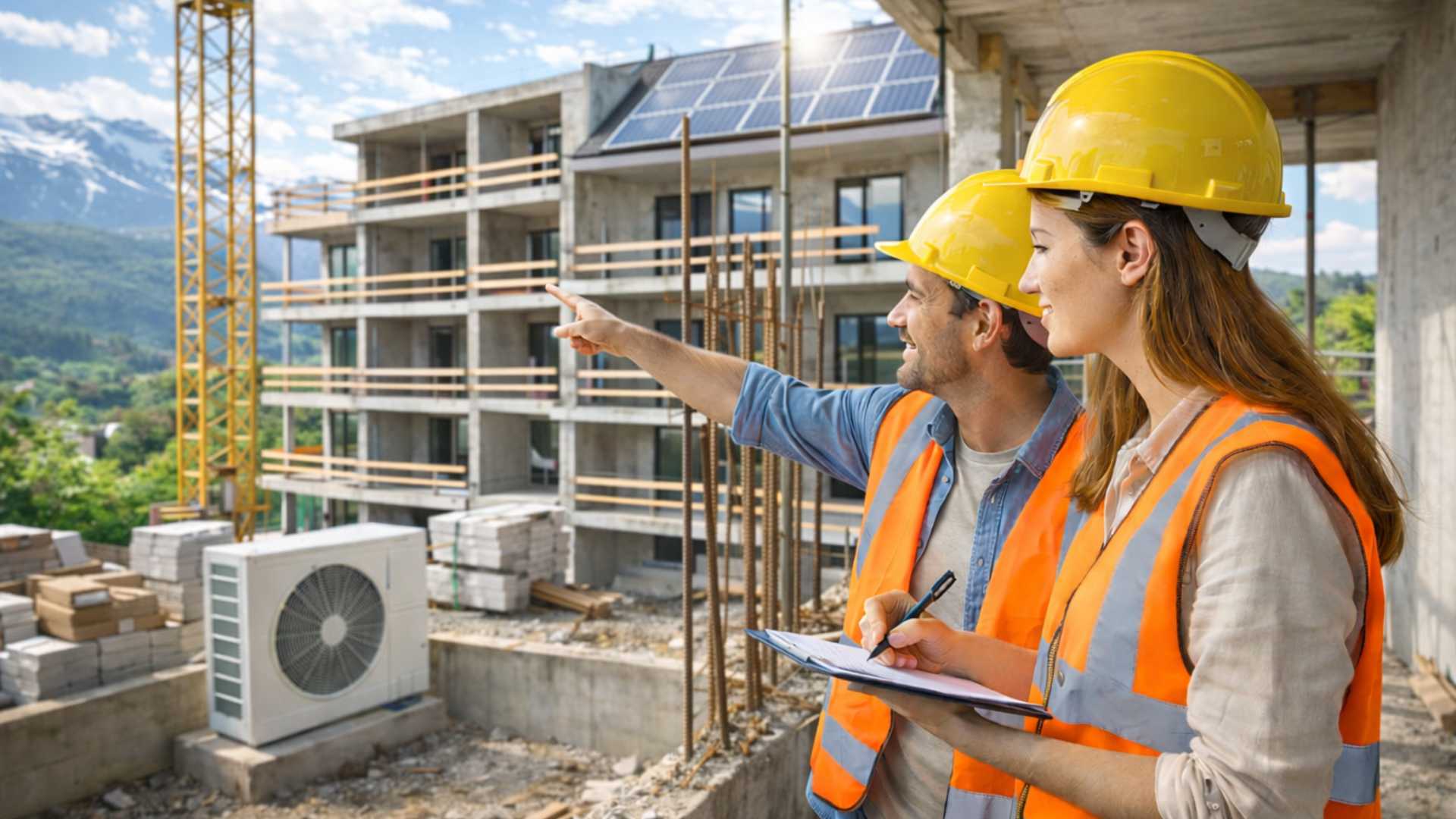
Buying a property off-plan now represents a major share of transactions in French-speaking Switzerland, as the existing property market is saturated:
- To buy an off-plan apartment, you have two options: a forward sale or a co-ownership land share purchase.
- With this type of acquisition, you can generally choose the finishes (kitchen, flooring, sanitary fittings) and sometimes modify the layout of internal partitions, depending on the stage of construction.
- To finance your property, banks generally require 20% equity, of which at least 10% must not come from the second pillar (pension fund).
Why buy off-plan property in Switzerland?
Investing in a new development allows you to benefit from a home built to current standards while securing your finances in the long term:
- Energy efficiency: Minergie or equivalent standards ensure high-performance insulation and reduced heating consumption.
- Budget certainty: Unexpected issues associated with older properties are avoided. No major renovations are expected for the next twenty years.
- Lower charges: The use of heat pumps and solar panels sustainably reduces condominium costs.
- Sustainable asset: A property built to modern standards retains better resale value and avoids energy obsolescence.
- Modern features: You benefit from recent technologies such as smart home systems and electric vehicle charging infrastructure.
Good to know: At the time of key handover, you have a legal period to report any defects. At this stage, we recommend calling in a building expert to document every detail in the handover report.
Buying off-plan in 2026: how much does it cost?
The price of new off-plan properties in the first quarter of 2026 depends heavily on location and standard. Below are the average prices per m² for condominiums:
| Canton | Average price per m² (Apartment) | Average price per m² (House) |
| Geneva |
15 500 CHF - 17 000 CHF |
15 600 CHF - 18 000 CHF |
| Zug |
15 700 CHF - 17 200 CHF |
15 500 CHF - 16 500 CHF |
| Zurich |
11 500 CHF - 16 800 CHF |
10 700 CHF - 16 200 CHF |
| Vaud (Lausanne) |
11 400 CHF - 13 800 CHF |
10 000 CHF - 11 500 CHF |
| Basel-City |
10 800 CHF - 11 000 CHF |
10 200 CHF - 11 600 CHF |
| Valais (Sion/Martigny) |
5 700 CHF - 6 500 CHF |
5 800 CHF - 6 600 CHF |
| Fribourg |
6 500 CHF - 7 400 CHF |
6 500 CHF - 7 300 CHF |
| Jura |
4 400 CHF - 5 100 CHF |
4 100 CHF - 5 400 CHF |
Forward sale and land share purchase: the two methods for buying off-plan
Swiss law provides two main legal structures to frame your purchase, depending on whether you prioritize payment simplicity or tax efficiency.
| Feature | Forward sale | Land share purchase |
| Transfer of ownership | At key handover | Upon signing at the notary |
| Notary fees | Calculated on the total purchase price | Calculated only on the land share |
| Payments | Initial deposit, balance at completion | In installments according to progress |
| Double financial burden | Avoided (rent + interest at the end) | Progressive (interim interest) |
Forward sale
This option is suitable for buyers who want to limit capital outlay during construction:
- A notarized deed is signed to fix the price and delivery date.
- A deposit (10% to 20%) is paid into a secure escrow account.
- The balance is paid only upon the actual transfer of ownership.
Land share purchase
This method allows you to reduce cantonal taxes, particularly in cantons such as Vaud or Geneva:
- You immediately become the owner of your share of the land.
- A general contractor agreement governs construction and guarantees.
- Payment calls follow a structured schedule: start of construction, structural work, topping-out, and finishing.
Financing an off-plan property project
Structuring financing for an off-plan purchase differs from a traditional purchase, as it requires progressive fund releases by the bank throughout the construction process.
Equity structure
To approve your mortgage, banks require 20% equity:
- at least 10% in cash (personal savings, pillar 3a, or gifts);
- the remainder may come from the second pillar (pension fund) through withdrawal or pledge;
- notary fees and transfer taxes must be paid in addition to this equity, usually with liquid funds.
Note that withdrawing from your pension fund reduces your retirement benefits. Pledging is often preferable to maintain coverage in case of disability or death while still securing the loan.
Construction loan and consolidation
During construction, the bank provides a construction loan to pay invoices progressively. You pay interim interest only on the amounts already drawn, making the financial burden gradual until completion.
These interest payments are tax-deductible, which is helpful while you may still be paying rent.
At key handover, this loan is converted into a standard mortgage (SARON or fixed rate): this is called consolidation.
Good to know: You can lock in your future interest rate with a “forward mortgage,” protecting you against rising rates during construction.
FAQ: Everything you need to know about off-plan purchases
What is the typical deposit?
The deposit generally ranges between 10% and 20% of the purchase price. It is paid upon signing the contract to secure the unit.
Can you resell an off-plan property before completion?
Yes, it is technically possible to assign your purchase contract, but this often requires the developer’s approval and may have tax implications on capital gains. It is a complex transaction that requires expert advice.
What is the construction specification?
It is the contractual document detailing all materials, equipment, and budgets included in the sale price. It serves as the definitive reference in case of disputes regarding the quality of finishes.
Are notary fees higher for new builds?
On the contrary, if you purchase via a land share structure, fees are calculated only on the land value and not on construction costs. This can result in significant savings compared to buying an existing property of similar value.
What are the typical timelines for a real estate development in Switzerland?
From the start of construction to key handover, the average timeframe is between 18 and 24 months. This may vary depending on the size of the project and weather conditions during the construction phase.