
Electric cars: What charging means for real estate experts
EV charging can influence a tenant’s or buyer’s choice of home. This article explains how property professionals can describe charging points, pre-equipped parking spaces, usage costs and planned installations accurately, while keeping proposed legal changes separate from facilities that already exist.
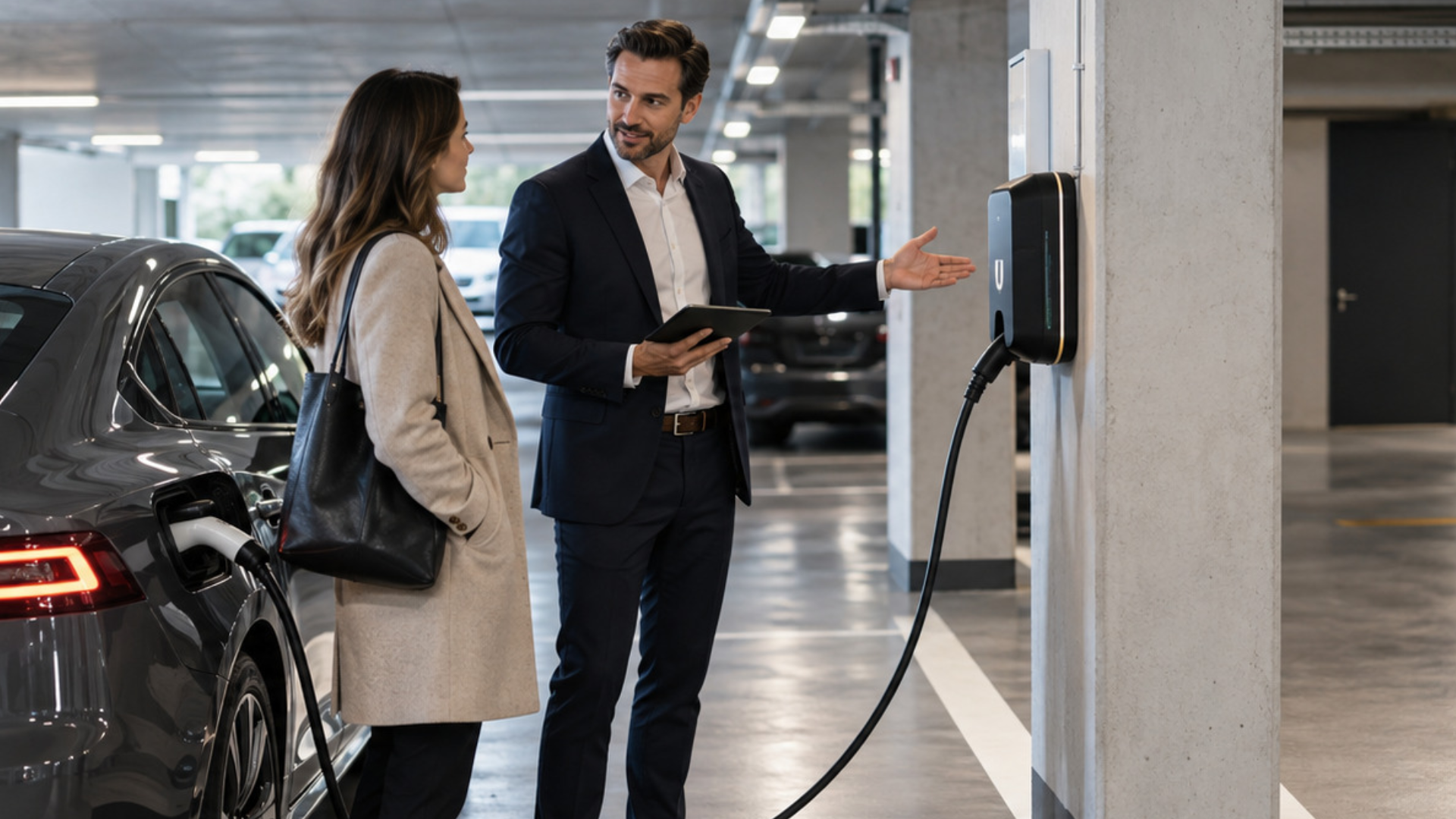
“Can I charge my car in the parking lot?” For tenants or buyers with electric vehicles, this question can be decisive when deciding on a property. Whether there are charging stations, whether there are parking spaces with charging infrastructure, and how the legal framework is developing – real estate experts must be able to describe exactly what the property offers.
According to auto-suisse, electric cars accounted for 35.7% of all new registrations in Switzerland and the Principality of Liechtenstein in September 2026. In the first nine months of the year, the share was 26.2%. These figures refer to new vehicles: they do not mean that one-third of the entire car fleet is already electric. However, they indicate a trend that is also relevant for property owners.
For a family that wants to move, charging is a matter of everyday use. Does the parking space fit the vehicle? Under what conditions can it be used? The property listing is the first place where these questions can be answered.
An available charging station and a prepared parking space do not promise the same thing
The term “electric charging station” can mean different things. For example, SuisseEnergie distinguishes between the basic equipment of a parking space, the preparation of a parking space and the actual installation and operation of a charging station. The SIA 2060 standard provides a framework for describing these levels of equipment.
This distinction could also be reflected in the advertisements. A parking space that is prepared for the installation of charging stations represents a development potential. It does not necessarily allow the new tenant to plug in their car immediately after moving in.
To avoid misunderstandings, the following formulations can be used as a starting point, which can be adapted to the specific situation:
Charging station in operation:
- “Parking space with charging station”; Conditions and rates available upon request.”
- Prepared parking space: “Parking space prepared for the installation of a charging station; additional equipment and conditions to be agreed upon.”
- Project in planning: “Installation of a charging station in the planning stage, with no availability or schedule.”
A shared charging station does not guarantee that every parking space equipped with a charging station is associated with a specific apartment. It must be clear who has access, under what conditions, and with what potential restrictions.
For portals, accuracy is as important as visibility
The availability of a charging option may be a selling point for some potential renters. However, the importance depends on the target audience, location, and other mobility options. It does not guarantee a faster rental or a higher sale price.
The marketing challenge is to make this feature understandable. If a portal offers a charging field, it must reflect the reality of the property. The description can then explain what the field does not cover: private or shared parking, working installation or pre-installation, additional costs.
The photos must also match the listing. A photo of a charging station in the garage is fine as long as it doesn’t give the impression that it belongs to the apartment if access depends on availability or a separate contract.
For the owner, the equipment also raises an operating cost issue
Before mentioning the charger, some points should be clarified: Who owns the charging station, who is responsible for maintenance, how is consumption billed, and what happens when the user leaves?
These answers allow the intermediary or the management to present the use costs beyond the simple parking space rental. Depending on the chosen solution, installation costs, a subscription or an energy cost bill may be added.
In a multi-family building, SuisseEnergie also emphasizes the need to coordinate owners, managers, planners and installers. Installation and operation must be considered together.
In a new building or a major renovation, planning a future-proof infrastructure can make it possible to equip parking spaces gradually. In existing buildings, the decision depends, among other things, on the electrical capacity, the parking layout, the requests received and the costs. The benefits of a shared solution should be assessed for the building in question.
A federal project that is not yet in force
On June 19, 2026, the Federal Council opened a consultation on an amendment to the Energy Act to facilitate home charging. The deadline expires on October 12, 2026. As of the time of writing, on October 9, this is still a project and not a federal regulation that has already come into force.
The text would require the installation of basic infrastructure for tenants who exclusively use a parking space with their apartment, including subtenants, under certain conditions. The installation should remain reasonable for the owner. This includes preparing the wiring, allocating the electricity consumption, and controlling the charging process. In the case of rental apartments, the costs could generally be passed on to the parking space rental price.
This infrastructure should be distinguished from the charging station itself. Therefore, advertising should not promise the future possibility of charging solely on the basis of the draft law.
Information to be included in the marketing file
The first step for professionals is to include a “charging” section in the list of property features: existing equipment, availability, access, costs and, if applicable, a confirmed project.
This work allows you to give more precise answers to potential buyers and to ensure a coherent presentation across the various distribution channels. Charging thus becomes a documented feature of the apartment, which everyone can evaluate according to their needs.
Sources
auto.swiss - Article
elcom.admin.ch - Article
suisseenergy.ch - Article
allnews.ch - Article
latele.ch - Article
romande-energie.ch - Article
admin.ch - Article
admin.ch - Article