
How to buy an apartment in Switzerland: Our complete guide
In a Swiss real estate market that remains highly competitive, purchasing a condominium apartment (PPE) has become the preferred solution for many households.
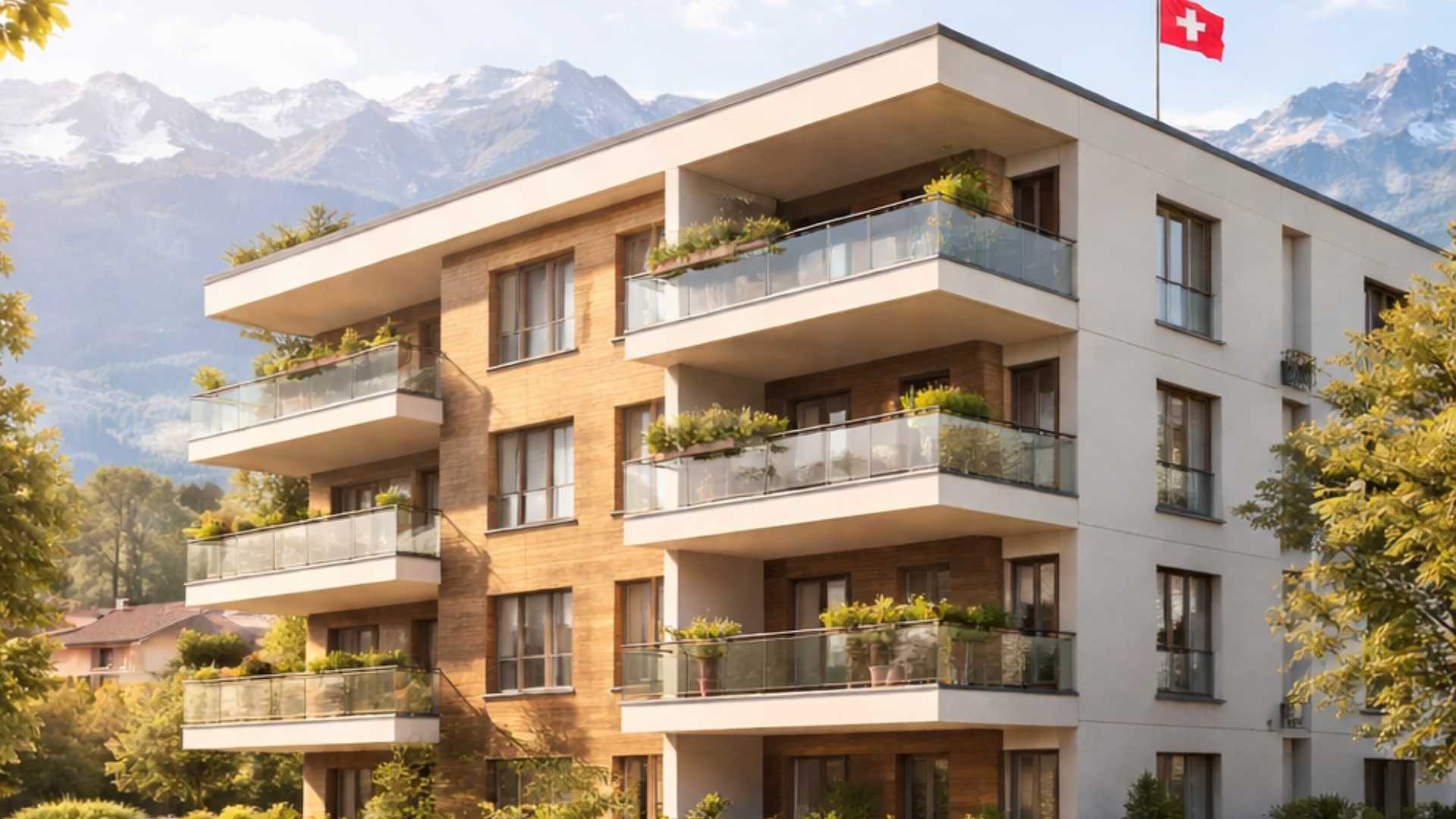
To purchase a property under Condominium Ownership (PPE), the conditions are broadly the same as for the acquisition of a single-family house, with a few differences:
- Purchasing under PPE grants an exclusive right to a dwelling and a quantified co-ownership share of the common parts, recorded in the Land Register.
- Beyond the purchase price, you must pay advance payments for charges in order to cover management fees, heating, routine maintenance, caretaking services, and insurance.
- By becoming a co-owner, you are required to comply with the RAU (Regulation of Administration and Use), which governs communal living and imposes restrictions.
How does Condominium Ownership (PPE) work?
Regardless of your canton of residence, the majority of apartments are sold under the PPE regime.
What is PPE?
PPE is a form of co-ownership in which you own a personal share with an exclusive right of use over a floor unit (your "private parts") and a proportional share (expressed in thousandths or co-ownership shares) of the common parts (land, roof, staircases, elevator).
The co-ownership regulations and the administrator
Each PPE is governed by a Constitutive Deed filed with the Land Register, which generally contains (or is supplemented by) the Regulation of Administration and Use (RAU).
It defines the division of the building into floor units and sets the co-ownership shares (in thousandths or hundredths). This figure determines your voting weight at general meetings and your share of the charges. As for the RAU, it specifies:
-
The allocation of charges: who pays what (elevator, heating, caretaking).
-
The attribution of specific rights of use: for example, if a garden is a “common part” but only the ground-floor apartment has the right to use it.
-
The majority rules: to decide on renovation works or aesthetic changes.
-
The role of the administrator: their powers and responsibilities.
Comparison of your rights under PPE
| Type of right | What you manage alone | What requires a vote |
|---|---|---|
| Exclusive right | Interior decoration, kitchen, floors. | Load-bearing walls, windows (exterior appearance). |
| Common areas | Use of the elevator, stairs. | Facade renovation, heating change. |
| Particular usage right | Enjoyment of a garden or a balcony. | Any structural modification of these areas. |
The renovation fund: your insurance against unforeseen events
It is, in a way, the building’s savings account. Each co-owner pays an annual contribution to anticipate major renovations (facades, roof, heating). Be careful, as the Civil Code does not legally require its creation (art. 712l CC).
Expert advice: before buying, request the last three minutes of the general meetings. If the fund is empty and the roof needs to be redone, you will have to pay thousands of francs out of your own pocket immediately after the purchase.
How to finance the purchase of a condominium unit?
In Switzerland, access to home ownership is governed by strict guidelines issued by the SBA (Swiss Bankers Association) and FINMA. To buy an apartment, you generally must contribute at least 20% of the purchase price in the form of equity.
The 20% equity rule
To buy, you must pay at least 20% of the property value out of your own pocket. However, the source of this money is strictly regulated:
-
The mandatory 10% in cash: at least half of your equity (i.e. 10% of the sale price) must come from your direct savings, a third pillar, or an advance on inheritance.
-
Use of the second pillar (LPP): you may use your occupational pension assets to cover the remaining 10%. You can either withdraw the money (which reduces your future retirement benefits) or pledge it (which serves as collateral for the bank without touching the capital).
The pitfall to avoid: the bank bases its calculation on the "lending value" of the property. If you buy an apartment for CHF 1,000,000 but the bank’s expert values it at CHF 900,000, you will have to pay the CHF 100,000 difference out of your own pocket, in addition to the 20% equity.
Stress test: why the bank simulates a 5% interest rate
Having the required equity is not sufficient to validate your financing. The bank also checks your debt-servicing capacity.
It uses a theoretical interest rate of 5% to ensure that you could still pay your monthly installments in the event of a crisis.
The rule is simple: total housing costs (interest, amortization, and maintenance costs estimated at 1%) must not exceed 33% of your gross annual income.
Checklist before buying a condo (PPE)
-
Ask for the last 3 minutes of the general assembly.
-
Check the state of the renovation fund.
-
Read the RAU (pets allowed? liberal professions?).
-
Calculate the monthly PPE fees.
What are the steps to buying a condominium unit?
The acquisition of an apartment is a public-law procedure that is strictly regulated. The notary acts as an impartial public officer, guaranteeing the legal security of the transaction for the buyer, the seller, and the financing institution.
The promise of sale and purchase
Once you have obtained your financing confirmation and the agreement on the price is sealed, the first step is to obtain the signing of a promise to sell and purchase.
To be valid, any promise of sale of real estate must take the form of a notarized deed signed before a notary. A simple private agreement (between individuals) has no legal value for transferring ownership.
Furthermore, it is customary to pay a deposit to the seller (5% to 10% of the price), deposited into the notary’s escrow account. These funds will only be released at the time of the effective transfer of ownership.
The notary’s verification role
Before drafting the final deed, the notary carries out essential searches in the Land Register. They verify:
-
The status of encumbrances: ensuring that no legal mortgage (for example from craftsmen or the tax authorities) burdens the property.
-
Easements: checking the rights and obligations attached to the land (rights of way, building restrictions, etc.).
-
PPE documents: the notary incorporates the Regulation of Administration and Use (RAU) into the deed and ensures that you have taken note of the allocation of the thousandths.
The deed of sale and the request for registration
Be careful: signing the deed of sale does not make you the immediate owner of the property. Under Swiss law, it is the entry in the Land Register that creates ownership rights.
On the day of signing, the notary reads the deed aloud. Once signed, they immediately submit a request for registration to the competent Land Register office. It is on the date and time of this filing that you officially become the owner of your apartment.
The management of mortgage certificates
To secure your loan, your bank requires the delivery of a mortgage certificate. This is a real estate security title.
If the seller already holds mortgage certificates on the apartment, the notary organizes their transfer to your bank. This is an advantageous operation as it avoids the costs of creating new certificates.
If the amount of your loan exceeds the value of the existing certificates, the notary must create new ones. Note that the Land Register fees and the notary’s fees for this operation are proportional to the amount of the claim.
Settlement of taxes and fees
The notary also acts as a collector for the State. They calculate and collect:
-
Transfer duties: the tax on the transfer of ownership (varies by canton, approximately 2.2% to 3.3%, and 0% in Geneva with Casatax taxation).
-
Land Register fees.
-
Their own fees, set by a cantonal tariff.
Finally, the final signature triggers payment of the balance of the sale price. On the day the keys are handed over, a condition report is essential. Carefully check the operation of appliances and the condition of floors and sanitary installations. Once the report is signed, any apparent defects not reported will be at your expense.
Are you looking for your future nest? At dreamo.ch, we offer exceptional properties in every canton. Find your home now in Bulle, Fribourg, or Neuchâtel.
FAQ: Buying under PPE
Can you buy an apartment without equity?
No, Swiss banking guidelines require a minimum of 20% available funds. It is impossible to finance 100% of the purchase price with a mortgage.
What is the impact of an LPP withdrawal on my retirement?
Early withdrawal reduces your retirement benefits (pension and capital). This is why we recommend favoring “pledging” rather than withdrawal, in order to preserve your insurance coverage, if your income allows it.
Fixed-rate mortgage or SARON: which to choose?
The fixed rate offers budget security over 5 to 15 years. The SARON rate (indexed to the money market) is historically cheaper but fluctuates. The trend in 2026 is to mix both to balance risk and return.
Can a B permit holder buy an apartment?
Yes, holders of a B permit residing in Switzerland may acquire their primary residence without special authorization, just like Swiss citizens.
What is a mortgage certificate?
It is a security paper representing the bank’s claim on your property. It is registered in the Land Register and serves as a payment guarantee for your loan.