
What does a right of way consist of in Swiss law?
A right of way is an encumbrance imposed on a property owner (servient tenement) for the benefit of another (dominant tenement), requiring them to tolerate a right of passage across their land.
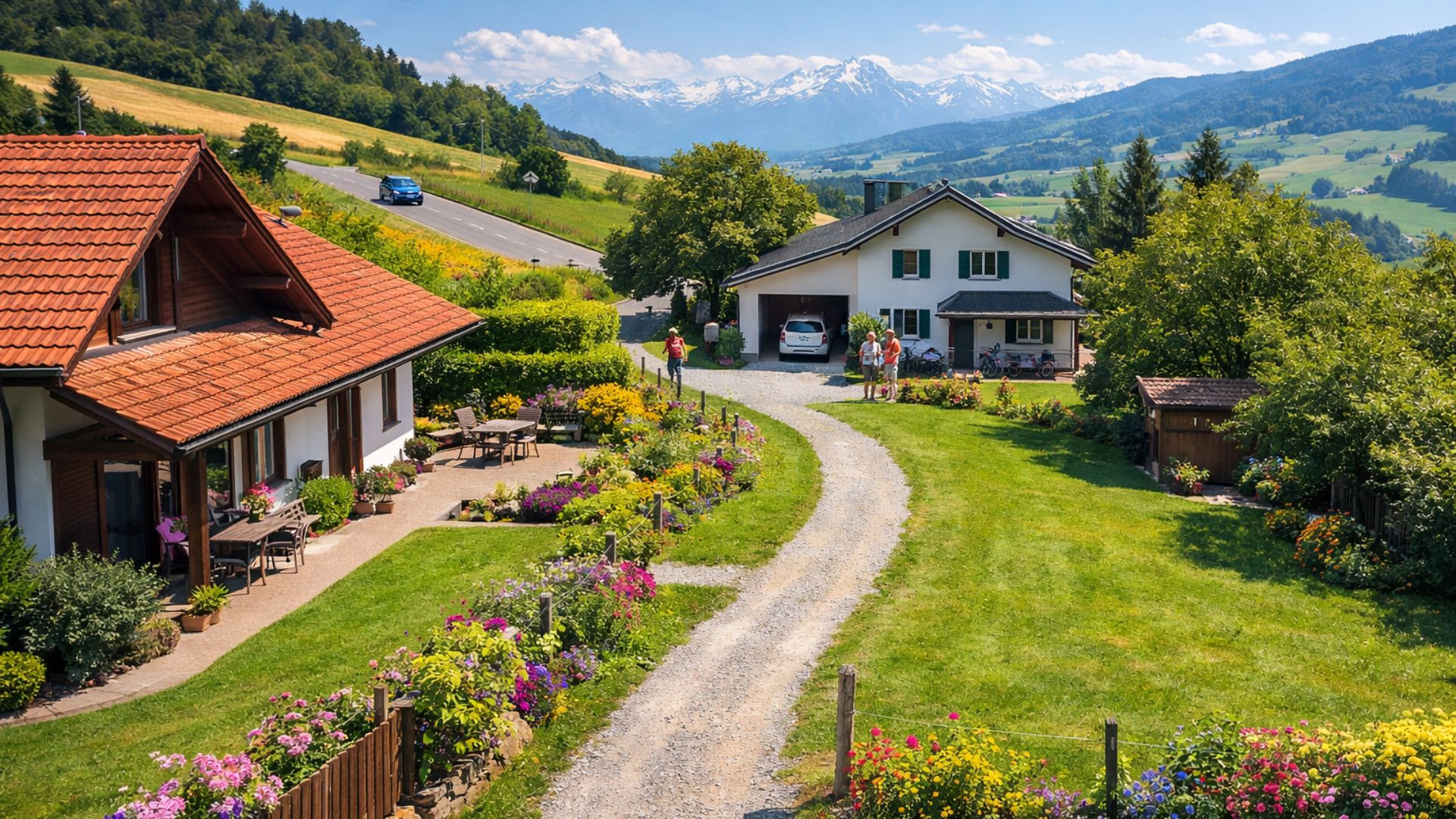
In Switzerland, the configuration of certain plots of land sometimes imposes compromises between owners. Indeed, it may happen that you have to cross your neighbor’s land to access your garage or tolerate the passage of third parties across your lawn:
- In real estate law, a right of way easement constitutes a burden imposed on a parcel of land for the benefit of another owner.
- Its purpose is to guarantee adequate access to the public road, particularly for landlocked plots.
- But beyond simple convenience, the right of way also governs responsibilities related to maintenance and the payment of possible compensation.
What is a right of way easement according to the Civil Code?
In Swiss law, a right of way easement constitutes a real burden on land. According to Art. 730 CC, it obliges the owner of one plot of land (the servient land) to tolerate that the owner of another plot (the dominant land) uses part of their property for passage. There are three common types of passage:
- Pedestrian passage: often for hiking paths or access to a forest area.
- Vehicle passage: to access a garage or parking space.
- Utility passage: for water, gas, or electricity pipelines (often linked to physical access).
Note: the easement transforms a simple neighborly tolerance into a lasting right recorded in the land register.
Necessary or contractual passage: how is the right created?
Contractual easement (by agreement)
This is the most common case: two neighbors agree on a right of way to facilitate access to a new construction.
To be legally binding, this agreement must be drawn up in authentic form by a notary and entered in the land register.
Necessary right of way (Art. 694 CC)
When a plot is "landlocked" (without sufficient access to the public road), the owner may require neighboring owners to grant the necessary passage in return for “full compensation.” The route is then chosen to be as short as possible and to cause the least damage to the land crossed.
In summary, whether the right arises from an amicable agreement or a legal necessity, its registration in the land register remains the only guarantee of its validity vis-à-vis future purchasers of both properties.
Rights and obligations: who can do what on the path?
The Civil Code imposes a delicate balance between the beneficiary and the landowner, governed by the rule of least damage (Art. 737 CC):
- The beneficiary (dominant land): has a right of use, but not a right of possession. They must use the path without causing unnecessary disturbance and strictly respect the route defined in the easement plan.
- The owner (servient land): retains full ownership of their land but must not carry out any act that hinders the exercise of the right of way (such as building a small wall, parking a vehicle permanently, or planting invasive hedges).
Respect for this balance is the cornerstone of neighbor law: any modification of use that increases the burden on the neighbor may be challenged before the competent authorities.
Maintenance and costs: who must pay for the works on the path?
The question of financing is the main source of disputes, which is why Article 741 of the Civil Code provides a structured answer to clarify the allocation of costs.
By default, maintenance of the path (snow removal, paving, pruning) is in principle the responsibility of the beneficiary of the right of way. However, if the landowner also uses the path for their own needs, the costs are then shared proportionally according to each party’s interest.
Our advice: always specify the cost-sharing arrangements in the notarial deed to avoid future conflicts during major renovations.
Can a right of way easement be modified or removed?
Contrary to a common belief, an easement recorded in the land register is not necessarily immutable. It may evolve or disappear under specific circumstances:
- Amicable buy-back: the owner of the servient land may “buy back” the easement if the neighbor no longer needs it.
- Loss of usefulness (Art. 736 CC): if a new public road is built and the land is no longer landlocked, the easement loses its purpose and may be cancelled.
- Lack of interest: if the easement no longer provides any benefit to the dominant land, a judge may order its removal.
Note that the extinction of an easement is a major legal act requiring an official modification in the land register so that the land regains its full freedom of use.
Neighbor disputes: what remedies exist in case of abuse?
In the face of obstruction (locked gate without a key, deliberate blocking), Swiss law offers effective protection tools for the affected owner:
- Dialogue and formal notice: a formal reminder of the rights recorded in the land register is often sufficient to defuse the situation.
- Civil mediation: it allows a compromise to be found without going through a long and costly judicial procedure.
- Legal action: a judge may order the cessation of the disturbance or, conversely, prohibit abusive use through "confessory" or "negatory" actions.
Ultimately, although the legal framework is protective, judicial proceedings should remain a last resort, as mediation often offers more sustainable solutions for peace between neighbors.
FAQ: Everything about the right of way
What is the minimum width of a right of way for cars?
The Civil Code does not set a universal measurement. However, VSS standards (Swiss Association of Road and Transport Professionals) and municipal regulations serve as references. Generally, a width of 3 meters is accepted for a standard vehicular passage, allowing emergency vehicles to pass.
Can a right of way be acquired by prescription (usucapion)?
No. The law does not provide that one can become the owner of a right of way simply by having used it for 30 years. An easement must be entered in the land register to exist legally.
Who must clear snow on a path subject to an easement?
According to Art. 741 CC, maintenance costs are borne by the person who uses the easement. If you are the only one using the path to access your house, snow removal is your responsibility. If the path is shared with the landowner, the costs (or effort) must be divided proportionally to usage.
Is a right of way easement attached to a person or to the land?
In Switzerland, it is almost always a real easement attached to the land. This means it is linked to the parcel and not to the current owner. If you sell your house, the right of way is automatically transferred to the new buyer.