
Swiss Real Estate Market 2025: Trends and perspectives
While the market remains stable, interest rates remain rather high, and in 2025 buyers prefer to turn to less expensive cantons rather than central ones.
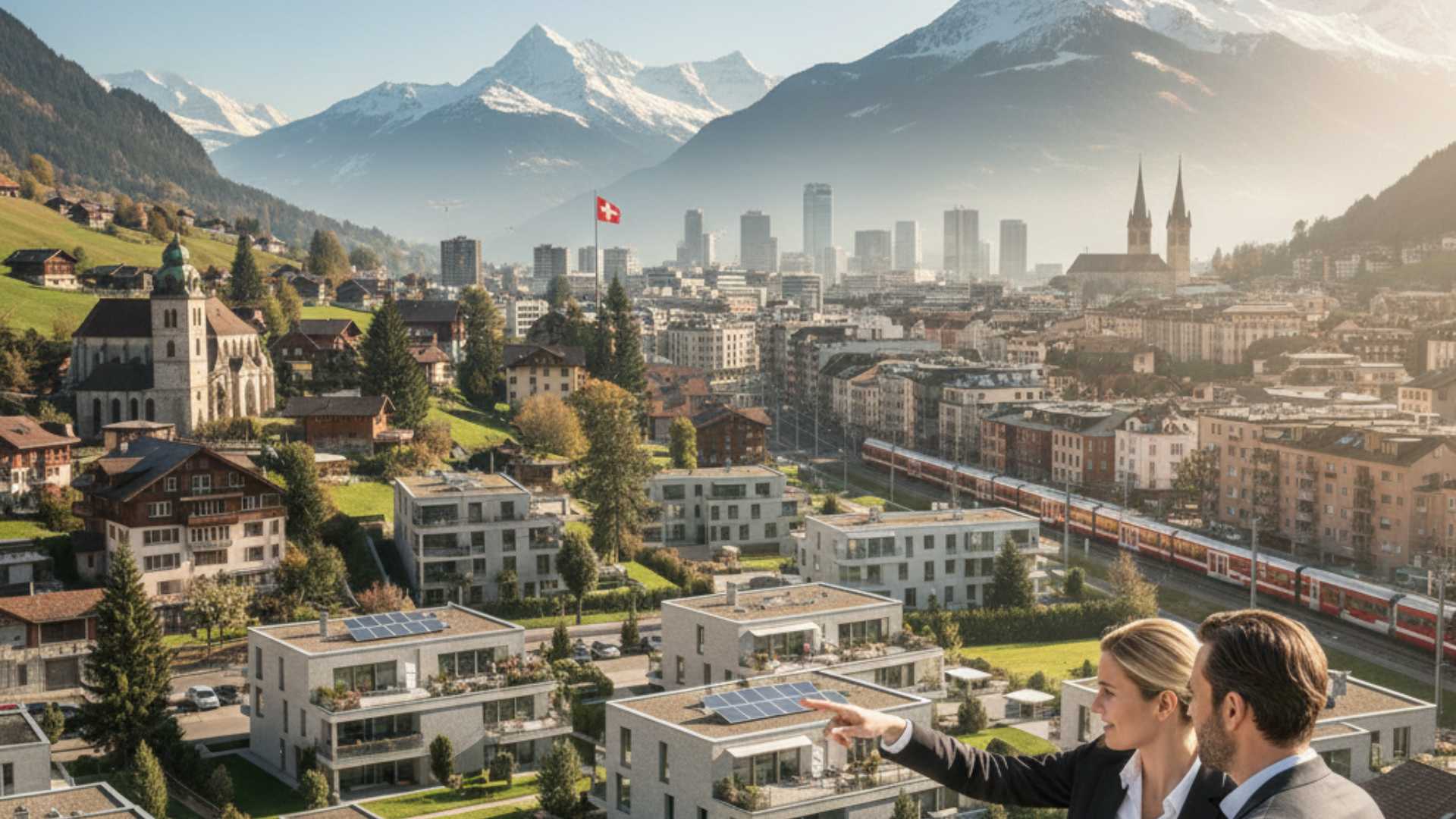
Despite economic tensions on a global scale, the Swiss real estate market maintains remarkable resilience. Demand remains high while supply struggles to keep up, which keeps prices at elevated levels in many cantons. This reality makes access to home ownership more complex for a growing number of households with:
-
Pressure on prices fuelled by a lasting imbalance between supply and demand;
-
Structural factors (demography, monetary stability, cantonal taxation) that reinforce attractiveness;
-
New challenges: rising interest rates, energy constraints and strong regional variation.
Current overview of the Swiss real estate market
Between persistent demand and a supply that struggles to follow, the dynamics of the Swiss real estate market in 2025 can be summarised as a fragile balance.
Price trends: a two-speed market
Prices on the residential market continue a slight increase.
According to the Real Advisor Barometer – Q2 2025 (1), apartment prices increased by +1.2% and single-family house prices by +1.0% in the second quarter of 2025. In the first quarter of 2025, apartments had already recorded an increase of +0.4% and houses of +0.3%. (2)
Moreover, the median price for a house amounts to CHF 1,379,868 and that for an apartment to CHF 950,107, with an average price per m² of CHF 9,224 for apartments. (3)
The supply crisis and low vacancy
The vacancy rate remains historically low, particularly in French-speaking cantons and urban centres. New constructions progress slowly due to regulations, costs and the availability of land. This shortage of supply reinforces the pressure on prices.
Interest rates: the breaking factor
The return of higher mortgage rates, a consequence of the monetary normalisation by the Swiss National Bank (SNB), changes the conditions of access to home ownership.
Indeed, banks are increasingly strict regarding households' debt capacity according to the one-third rule: housing-related costs must not exceed 33% of gross income.
Swiss real estate prices by canton in 2025
Price differences across Switzerland remain considerable, reflecting the country’s economic and geographical diversity.
| Canton |
Average price per m² (house) |
Average price per m² (apartment) |
|---|---|---|
| Geneva |
|
approx. 14,000 CHF |
| Vaud | approx. 11,000 CHF | approx. 10,000 CHF |
| Zurich | approx. 14,000 CHF |
|
| Zug | approx. 13,000 CHF | approx. 11,500 CHF |
| Fribourg |
|
approx. 7,500 CHF |
| Valais |
|
approx. 6,500 CHF |
| Neuchâtel | approx. 7,500 CHF | approx. 7,000 CHF |
| Jura |
|
approx. 5,800 CHF |
Urban centers concentrate the highest prices, while peripheral cantons gain in attractiveness.
Beyond main residences: overview of the key segments of the market
The evolution of the Swiss market is not limited only to dwellings, it also concerns rental investments and the tertiary market.
Condominium ownership (PPE) and access to ownership
PPE remains the preferred path for households wishing to buy an apartment. Less expensive than a single-family house, it allows a first access to ownership, often in urban areas.
However, co-ownership charges, the renovation fund and collective management can represent a financial obstacle for potential buyers.
Investment property
The rise in purchase prices and in interest rates has tightened profitability margins. This is why institutional investors now favor more selective investments: well-located buildings, energy-efficient constructions or renovation projects...
In addition, the income value method tends to become stricter, which reduces the potential for quick added value.
Offices and commercial spaces
Since the pandemic, remote work has changed the demand for administrative space. This is why large urban areas are rationalizing their square meters, while peripheral areas struggle to absorb the existing supply.
The strategic centers (Zurich, Lausanne, Geneva) nevertheless maintain strong attractiveness thanks to the concentration of international companies and high value-added services.
What challenges and perspectives for the future of the Swiss real estate market
The Swiss real estate market is entering a phase of adjustment: the years of continuous growth are giving way to a more selective balance.
Evolution of interest rates and impact on accessibility
The SNB has maintained a cautious monetary policy, with a reduction of its main policy rate to 0 percent in June 2025. This situation has led to a decrease in mortgage rates, making financing more accessible.
However, credit granting criteria remain strict, especially concerning the financial capacity required by banking institutions.
The challenge of ecology and energy efficiency
In the coming years, owners will have to invest more in energy renovation, otherwise they risk seeing the value of their property decrease. The green value of a property (energy performance, sustainable materials, low emissions) already constitutes a decisive criterion for both sale and financing.
Regional disparities: French-speaking Switzerland vs German-speaking Switzerland
If one considers the price differences between Geneva/Vaud and Zurich/Zug, the gap remains significant, but growth is now extending to peripheral cantons.
Thus, we observe a residential exodus toward Valais, Fribourg or Solothurn, proof of a paradigm shift for Swiss residents. Now, accessibility takes priority over centrality, which gradually increases the attractiveness and value of these cantons.
You will have understood, the real estate market is still destined to evolve in the coming years, or even the coming months. Between high interest rates, scarcity of supply and new energy obligations, buying a house or an apartment in Switzerland may require being accompanied by an expert.
Do you have a real estate project
dreamo.ch provides its local expertise and its analysis tools to guide every future owner, from budget calculation to the realization of the project.
Sources
realadvisor.ch - Article
investir.ch - Article
realadvisor.ch - Article