
Our Tips for Choosing the Right Type of Property to Buy in 2026
The choice between a house, an apartment, a new-build or an existing property depends directly on your available budget, the level of ongoing costs you are willing to accept, and your long-term plans.
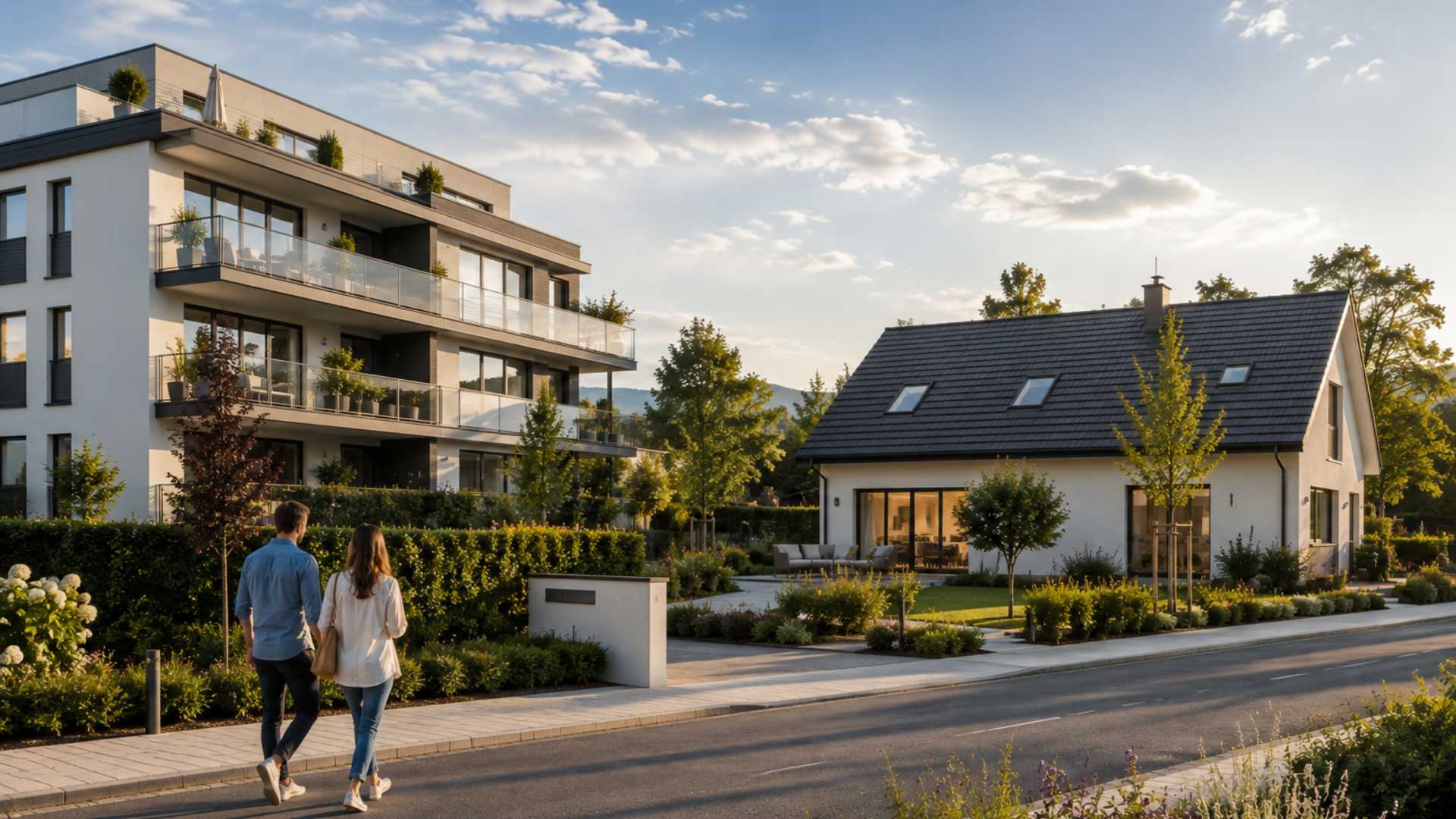
Two buyers with the same budget will not necessarily choose the same type of property. Ongoing costs, financing requirements and location all lead to very different decisions depending on each buyer's circumstances.
-
With the same budget, a house generally offers more living space but also significantly higher maintenance costs.
-
A well-located apartment may retain its value better than a larger property on the outskirts of a city.
-
The choice between a new-build and an existing property depends mainly on your ability to finance renovation work during the first few years.
House or Apartment: Which Option Best Suits Your Situation?
The right choice depends less on personal preference than on your overall financial capacity and lifestyle. With the same budget, each option involves different compromises.
Buying an Apartment
With a budget of around CHF 900,000, buyers can generally expect to purchase a 70 to 100 m² apartment in a modern condominium building located in an urban area. This type of property is particularly attractive to professionals who prioritise location and ease of maintenance.
For example, a couple with a stable income and CHF 200,000 in equity chooses a 3.5-room condominium close to a railway station. Their objective is to minimise commuting time while protecting the property's long-term resale value. They are willing to pay monthly condominium fees of CHF 400 to CHF 700 in exchange for not having to manage building maintenance themselves.
This option is particularly suitable when commuting time and resale potential are key priorities.
Advantages
-
Access to central urban locations.
-
Better control over the overall purchase budget.
-
Easier resale in high-demand areas.
Limitations
-
Condominium fees can be relatively high depending on the building's amenities.
-
Major renovation decisions must be approved collectively by the co-owners.
-
Limited or no private outdoor space.
Buying a House
A detached house on the outskirts of a major city typically costs between CHF 1.2 million and CHF 2 million, depending on its location. While the purchase price is higher, buyers benefit from more living space and greater independence.
For example, a family with two children purchases a 140 m² house with a garden. Although financing is more demanding, their decision is driven by the need for additional space, a quieter environment and a long-term outlook over the next 10 to 15 years. They must also budget between CHF 10,000 and CHF 20,000 per year for maintenance, heating, roof repairs and outdoor upkeep.
This option is particularly appropriate when long-term family stability is more important than flexibility.
Advantages
-
Significantly larger living space and private land.
-
No condominium association and complete management autonomy.
-
Strong potential for extensions or renovations.
Limitations
-
Higher overall purchase budget.
-
All maintenance costs are borne by the owner.
-
Greater exposure to energy costs and the age of the building.
New-Build or Existing Property: Immediate Peace of Mind or Long-Term Value Potential?
This decision mainly depends on how much renovation risk you are willing to accept and how important predictable costs are to you.
Buying an Existing Property
An older apartment may cost between 10% and 25% less than a comparable new-build property, but it often requires a substantial renovation budget.
For example, a buyer purchases a four-room apartment in a building dating from the 1980s for CHF 850,000. They plan to invest between CHF 60,000 and CHF 120,000 in renovating the kitchen, replacing the windows and improving part of the insulation. Their decision is driven by the opportunity to buy in a central location that would be unattainable in a new development with the same budget.
This type of purchase is particularly suitable for buyers who are comfortable completing their project in several stages.
Advantages
-
Lower initial purchase price.
-
Strong potential for value appreciation after renovation.
Limitations
-
Renovation work can be extensive and difficult to predict.
-
Energy performance varies considerably from one property to another.
-
Without a professional assessment, the total cost of ownership can be difficult to estimate.
Buying a New-Build Property
A newly built four-room condominium in a well-connected area typically costs between CHF 1,000,000 and CHF 1,300,000. Although the purchase price is higher, renovation costs are virtually non-existent in the short term.
For example, a buyer chooses an apartment purchased off-plan that will be completed in two years. Their decision is motivated by greater energy efficiency and predictable ownership costs. Maintenance expenses are almost zero during the first few years, making financial planning much easier.
This option is particularly suitable for buyers looking for greater financial certainty.
Advantages
-
Very little renovation work required in the short term.
-
Modern energy efficiency standards.
-
Developer warranties covering several years.
Limitations
-
Higher purchase price.
-
Fewer properties available in city centres.
-
Waiting period between purchase and completion.
Primary Residence or Rental Investment: Two Completely Different Objectives
A property intended as a primary residence is selected according to very different criteria from one purchased as a rental investment. In the first case, everyday living needs take priority. In the second, rental performance and long-term income stability become the main focus.
Buying a Home to Live In: Prioritising Quality of Life
Purchasing a primary residence is above all about meeting your day-to-day living needs. The property should provide comfort and convenience rather than simply represent a financial investment. The most important selection criteria generally include:
-
Proximity to your workplace or public transport.
-
Overall quality of life, including a quiet location, natural light and a pleasant environment.
-
A layout suited to your household's needs.
-
A manageable commuting time, ideally no more than 30 to 40 minutes.
In this context, financial considerations often become secondary to everyday comfort. A practical example:
A professional has a budget of approximately CHF 900,000. They choose an apartment close to a railway station rather than a larger house on the outskirts or a newer property in a less accessible location. The result is a smaller living space and potentially higher condominium fees, but significantly improved quality of life and much shorter commuting times.
Buying a Rental Investment: Maximising Returns and Rental Demand
When purchasing an investment property, the objective is to generate stable rental income while minimising vacancy periods. Buyers therefore pay particular attention to:
-
A location with strong rental demand.
-
Proximity to public transport, universities or major employment centres.
-
Property types that are easy to rent, such as studio or one-bedroom apartments.
-
Reasonable operating costs in order to preserve profitability.
Budgets for this type of investment generally range between CHF 400,000 and CHF 700,000 for smaller properties located in urban or semi-central areas.For example:
An investor purchases a studio apartment in a well-connected neighbourhood with the objective of finding tenants quickly and keeping vacancy periods to a minimum. The property is selected for its rental appeal rather than for the investor's personal comfort. The key purchasing criteria are:
-
The property's location, which is the primary driver of rental demand.
-
Ease of re-letting, making the property attractive to a wide range of tenants.
-
Stable returns through consistent rental income over the long term.
Which Type of Property Should You Buy in 2026? Our Summary Comparison Table
| Criteria | Apartment | House | New-Build | Existing Property |
|---|---|---|---|---|
| Typical budget | CHF 700k–1.2M | CHF 1.2M–2M | CHF 900k–1.4M | CHF 600k–1.3M |
| Annual costs | Condominium fees: CHF 4k–10k | Maintenance: CHF 10k–20k | Low at first | Variable |
| Location | City centres and railway stations | Outskirts | Mixed | Often centrally located |
| Renovation work | Limited | Frequent | Very limited | Significant |
| Typical buyer profile | Urban professionals | Families | Buyers seeking financial certainty | Buyers focused on value for money |
FAQ
Which type of property is the easiest to finance?
An apartment in an urban area generally requires a lower down payment than a house of a similar size, as the overall purchase price is usually lower.
House or apartment: which generates the highest costs over a 10-year period?
A house generally involves higher maintenance costs than an apartment, particularly for the roof, heating system and outdoor areas. Over a 10-year period, these expenses are often significantly higher than the condominium fees associated with an apartment.
Does buying a new-build reduce long-term costs?
Yes, particularly during the first few years, as little or no renovation work is required. However, the higher purchase price partly offsets this advantage over the long term.
Is an older property a more profitable investment?
It can be, provided the lower purchase price more than compensates for the renovation costs and the property's location ensures stable rental demand over time.
What is the most important factor when buying a property?
Location is the key criterion, as it determines both the property's resale value and its rental potential, regardless of the type of property.