
What are the financing criteria for buying a second home in 2026?
Buying a second home in Switzerland is subject to stricter financing requirements than purchasing a primary residence. For example, you must provide at least 33% in equity.
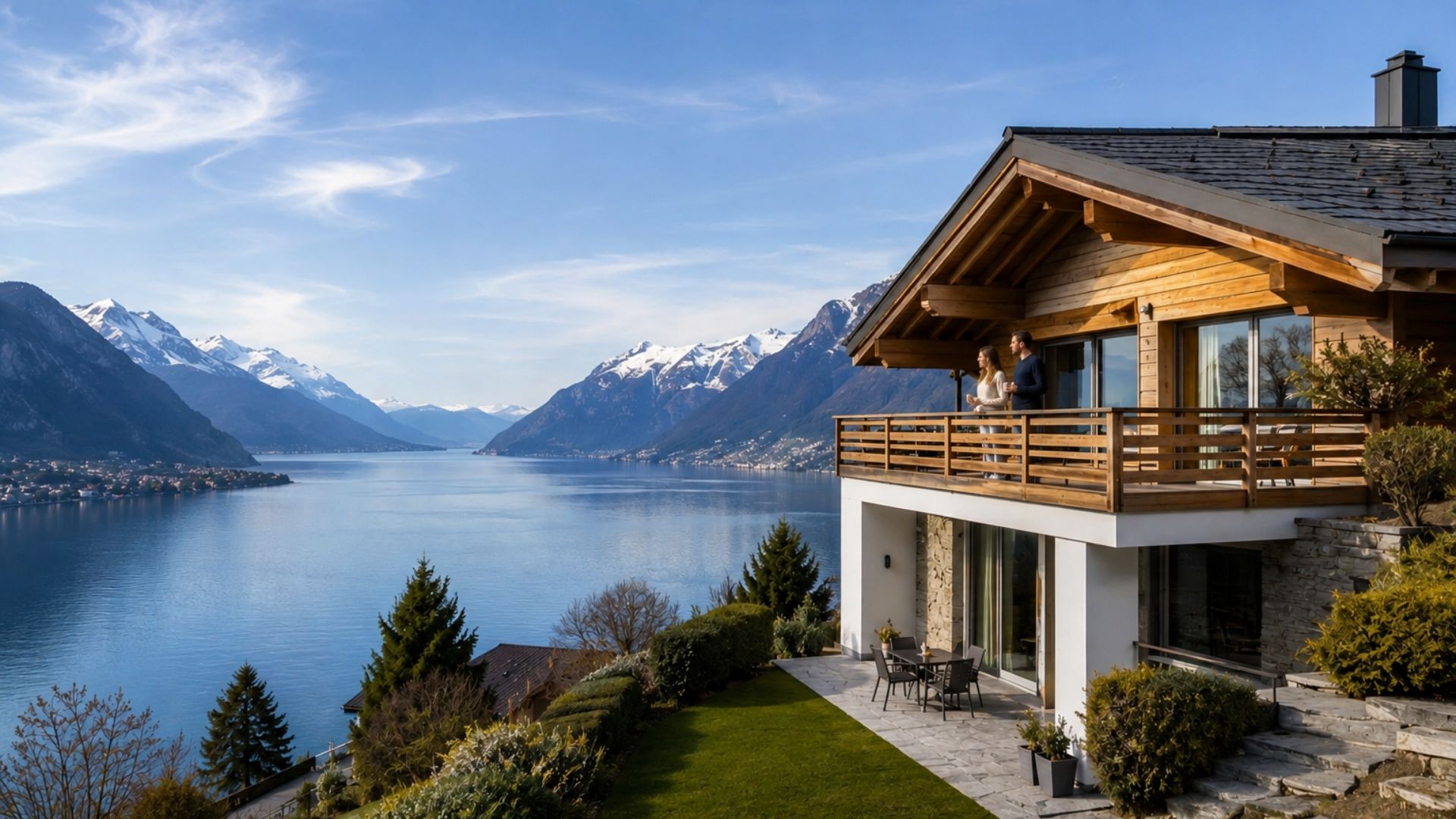
Two factors primarily determine whether your project is financially feasible: your borrowing capacity and the amount of your own funds. Lenders also assess several additional criteria:
- Banks generally grant a mortgage covering up to two-thirds of the property’s value. The buyer must finance the remaining amount with their own funds.
- Buyers must provide at least 33% in equity, compared with 20% for a primary residence in most cases.
- Financial affordability is calculated using theoretical interest rates, generally between 4.5% and 5%, to ensure that the borrower would be able to cope with a potential rise in interest rates.
A higher equity requirement for a second home
Second homes are considered riskier by banks, as they are often the first property to be sold in the event of financial difficulties. This higher level of risk explains the stricter equity requirements.
Bank financing often limited to 66% or 80%
In practice, Swiss banks generally limit the financing of a holiday home to 66% of its market value.
Unlike a primary residence, which may be purchased with 20% equity, a second home requires at least 33% to 35% in so-called “hard” equity (cash, Pillar 3a assets, gifts). Assets from the second pillar cannot be withdrawn to finance this type of property.
The exact financing ratio and lending conditions depend in particular on:
- the location and attractiveness of the property;
- its valuation by the bank;
- its long-term resale potential;
- the borrower’s overall financial affordability, taking all existing financial commitments into account.
Equity that is immediately available
The buyer’s equity must generally consist of assets that are readily available:
- bank savings;
- securities or financial investments;
- gifts;
- proceeds from the sale of another property.
In most cases, second-pillar pension assets (BVG/LPP) cannot be used to finance a second home. Banks favour readily available equity in order to limit their exposure to risk.
Financial affordability assessed using conservative criteria
The interest rate actually offered on the mortgage is not the rate used to determine your borrowing capacity.
Banks perform a stress-test calculation based on a theoretical mortgage interest rate of 5%, to which maintenance costs (generally estimated at 1% of the property’s value) and amortisation costs are added.
The total of these theoretical costs must not exceed one-third of your gross income.
The affordability ratio remains a key factor
The annual cost of owning the property generally includes:
- interest calculated using the theoretical interest rate;
- estimated maintenance costs, often around 1% of the property’s value;
- any mandatory mortgage repayments.
As a general rule, the total of these theoretical costs should not exceed approximately one-third (33%) of the household’s gross income. This threshold may vary slightly depending on the lender, but it remains a widely used benchmark in the Swiss banking sector.
The income taken into account mainly includes salaries, sustainable income from self-employment and pension income.
Good to know: if the property is intended to be rented out for part of the year, seasonal rental income is treated cautiously. Banks often apply a 30% to 50% discount to this income or may exclude it entirely from their affordability calculations.
Often stricter amortisation requirements
Unlike a primary residence, where the mortgage debt is generally amortised from 80% to 66% of the property’s value, financing for a second home is capped at 66% of the property’s value from the outset.
Depending on the lender’s policy and the location of the property, banks may require additional amortisation to reduce the mortgage debt to 50% of the property’s market value, usually within 10 to 15 years or before retirement.
Two solutions are commonly offered:
- Direct amortisation, which involves gradually repaying the borrowed capital through regular payments. Interest costs decrease over time as the outstanding debt is reduced.
- Indirect amortisation, which involves paying the agreed amounts into a tied pension account or policy (Pillar 3a) or an investment product accepted by the bank and pledged in its favour. The capital is then repaid in a single payment at the agreed maturity date.
The latter option keeps the mortgage debt unchanged while providing tax advantages, as both Pillar 3a contributions and mortgage interest can be deducted from taxable income.
Tax considerations to include in the overall cost of the project
Purchasing a second home has several tax implications that should be taken into account when planning your budget.
As with a primary residence, the property is included in taxable wealth and may be subject to imputed rental value taxation in accordance with the tax rules applicable in the canton concerned.
| Tax element | How it works | Impact on the budget |
|---|---|---|
| Imputed rental value | Notional income based on the theoretical rental value | Increases taxable income |
| Wealth tax | The property’s taxable value is added to the owner’s assets | Taxed according to the rates applicable in the canton where the property is located |
| Mortgage interest | Deduction of mortgage interest paid | Reduces overall taxable income |
| Maintenance costs | Deduction of maintenance and renovation expenses | Partially offsets the imputed rental value |
| Real estate capital gains | Tax on the capital gain when the property is sold | Tax rate generally decreases depending on the length of ownership |
Acquisition costs should not be underestimated
In addition to your equity contribution and mortgage, several costs must be paid when purchasing the property. These include:
- property transfer taxes, where applicable in the canton;
- notary fees;
- land registry fees;
- costs associated with issuing or adjusting mortgage notes;
- any property valuation fees required by the bank.
The total amount varies considerably from one canton to another. It ranges from around 1.5% in cantons such as Valais to 3.5%, or even more than 4% of the purchase price in cantons such as Vaud, Geneva or Neuchâtel. These costs must be financed entirely from your own liquid assets, in addition to the equity required to purchase the property.
We also recommend setting aside a budget for initial renovation work, furnishing and ongoing maintenance, particularly if the property is intended for seasonal use.
FAQ
Can you finance a second home with only a 10% down payment?
In most cases, no. For a second home in Switzerland, banks require a significantly higher equity contribution than for a primary residence, generally between 33% and 50% of the property’s value.
Can second-pillar assets be used to finance a second home?
Under the Swiss legal framework governing the promotion of home ownership, second-pillar pension assets (BVG/LPP) cannot be withdrawn or pledged to finance the purchase of a second home intended for personal use.
Can a bank refuse financing despite a substantial equity contribution?
Yes. The decision depends primarily on overall financial affordability. The theoretical housing costs – interest calculated at 5%, amortisation and maintenance costs of around 1% – must not exceed one-third of your gross income. Income stability, the quality of the property and its valuation by the bank are equally important factors.
Are the criteria the same at every bank?
No. Each lender applies its own risk policy. Maximum loan-to-value ratios, requirements regarding the recognition of rental income and amortisation conditions may vary between cantonal banks, major banks and insurance companies.