
What really makes an internet user click on a real estate ad?
What makes users click on a real estate listing? Discover how photos, price, location and headlines impact visibility and qualified leads.
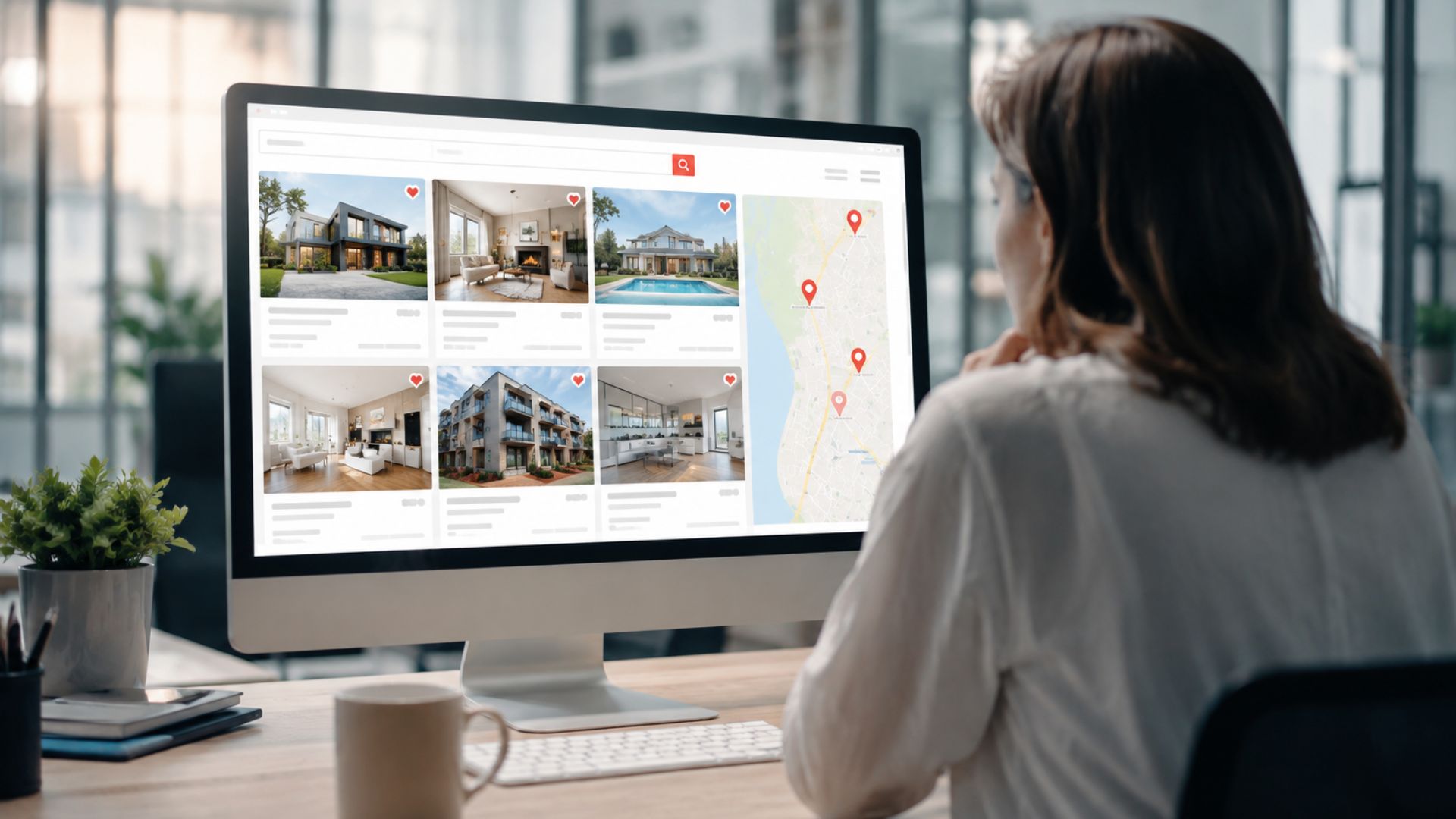
Photos, price, location, title, exterior view, energy performance: all these elements count, but not at the same time.
On a real estate portal, a click is often the result of a beautiful photo or a catchy title. The reality may be more complex. Before even comparing two listings, the user has usually already defined a zone, a price range, a type of property and sometimes a minimum number of rooms. The listing must therefore first appear in the right set of results. It must then attract attention, and then provide enough credible elements to warrant a consultation.
In other words, a listing does not generate clicks thanks to a single “magic ingredient.” It rather passes through three successive filters: relevance, attention and reassurance.
Filter 1: Actually matching the search
Price and location are often less of a marketing argument and more of a gatekeeper. If a property is outside the desired area or above the maximum budget, it can be filtered out before the main photo is even seen.
This is especially important in Switzerland, where supply is scarce in many regions. As of June 1, 2025, the country had only 48,455 vacant homes, or 1% of the total housing stock. In such a tight market, potential renters may broaden their criteria, but they also quickly compare offers that meet their immediate needs. For sales, where the financial commitment is much higher, the listed price also determines whether a property is even considered before its emotional qualities can come into play.
For professionals, this means a simple rule: structured data is not an administrative formality. A poorly described municipality, an imprecise category, a missing square footage, or an ambiguously presented price can all reduce visibility in filtered results. Click optimization therefore starts in the listing fields, before it even begins in the text.
Second filter: stopping the eye
Once the ad is present in the results list, the main photograph generally becomes its primary visual cue. Academic studies using eye-tracking show that images strongly structure attention to online real estate ads. Other research on digital ads also observes that a greater number of photographs and descriptions that focus more on the experience of living in the property are associated with better commercial outcomes. These studies do not specifically address Swiss portals and therefore cannot assign a click-through rate. However, they confirm the decisive role of visual presentation in the initial evaluation.
The first photo should answer a question, not just be aesthetically pleasing
The right cover image is not necessarily the most spectacular one. It’s the one that allows you to immediately understand the property’s proposition.
- For a villa, an exterior view can show the volume, the architecture, the land and the degree of privacy.
- For an urban apartment, a bright living room can better express the available space and the interior quality.
- For a property with a truly distinctive view, that view can become the best eye-catcher.
- For a property that needs renovation, an honest and readable image is often preferable to a flattering photograph that creates a false expectation.
However, the exterior view has a double function. It attracts when it reveals an architecture, a clearing or an environment that adds value. But it also reassures: it helps the internet user understand the building’s context. Removing it completely can create a lack of information, especially for a single-family home. Conversely, using it systematically as a cover image is not relevant if it mainly shows a parking lot, a plain façade or an unreadable environment.
Technical quality remains essential: natural framing, controlled verticals, believable lighting, visual order and appropriate resolution. But “improving” should never mean changing reality. A replaced sky, virtual furniture or major retouching should remain plausible and, when the image no longer represents the current state, should be clearly flagged. In the medium term, lost trust costs more than a click gained.
The price: a number, but above all a signal of consistency
The price operates at two levels. First, it determines the eligibility of the ad in the filters. Then, in the list of results, it is compared almost instantly with neighboring properties. The user does not just judge whether the amount is affordable: he or she also assesses what that amount seems to buy at that location.
A high-end photo combined with a surprisingly low price may attract a click, but it may also raise suspicion. Conversely, a price higher than the visible market references requires that the results card immediately make a difference clear: view, condition, exterior appearance, recent renovation, architectural rarity, or energy efficiency.
The goal is not to artificially create curiosity by hiding the price or using a misleading price. It is to make the relationship between price, location, and visual promise understandable in a few seconds. When these three signals contradict each other, even a very well-crafted ad may be ignored.
Location: from the commune to the micro-location
In real estate, “location” is not just the name of the commune. Accessibility, proximity to transport links, potential noise pollution, schools, services, sunshine, local taxes and the quality of the environment can all have a significant impact on how a particular address is perceived. Hedonic valuation models used on the Swiss market take several of these factors into account, as the value of the land and the property is closely linked to its location and the infrastructure available.
To generate a qualified click, it is therefore necessary to translate the micro-location into a concrete benefit. “6 minutes’ walk from the station” is more informative than “ideally located”. “South-west facing living room, overlooking the courtyard” answers both the light and noise questions. A map, a travel time or a view from the property can be more convincing than a string of adjectives.
When the exact address cannot be published, it is still useful to provide enough information for the user to estimate how well the property fits in with their daily life. Too much vagueness may increase curiosity, but it can also degrade the quality of the clicks and lead to more requests that do not result in a sale.
The title: useful for differentiation, but not enough to save the ad
The title is a small space in a sea of similar offers. It is not meant to repeat all the information already displayed on the portal, nor to pile on adjectives like “amazing,” “exceptional” or “must see”. It should highlight the most credible unique selling point of the property.
Some principles work particularly well:
- highlight a specific and verifiable advantage;
- tailor that advantage to the target segment;
- avoid interchangeable superlatives;
- don’t hide a key piece of information behind an enigmatic formula;
- maintain strict consistency between the title and the first photo.
For example, “Apartment with balcony, 5 minutes from the train station” already gives a reason to open the ad. “Amazing opportunity to discover quickly” doesn’t give any real reason specific to that property.
The title can therefore make the difference between two already relevant items, but it rarely compensates for a bad price positioning, a poorly readable photo or a location that doesn’t match the search.
Energy performance: rarely the first trigger, but increasingly a source of reassurance
Energy efficiency is not always visible on the results page and is probably not the first reason why most internet users click on a property. However, its importance increases as the buyer considers the costs, future renovation work, summer and winter comfort, the heating system, and the long-term value of the property.
In Switzerland, the CECB evaluates three dimensions: the efficiency of the building envelope, the overall energy efficiency, and direct CO₂ emissions. It therefore transforms a vague statement such as “energy-efficient building” into comparable information. A study of Minergie homes in the canton and city of Zurich has also shown that there is a green premium and has sought to identify the reasons behind it. This does not mean that a high energy class guarantees more clicks on all segments. However, it does show that sustainability can be economically valued and that it is worth making it visible when the information is available.
For an advertisement, energy performance should be translated into concrete elements: CECB class, Minergie label, type and year of heating system, renovated envelope, photovoltaic panels, ventilation, estimated energy consumption, or recent work done. This information can also be used in the title or cover photo if it represents a real competitive advantage.
Not all clicks are created equal
The click-through rate should not be the only measure of quality. A spectacular photo or an intriguing title can attract many visits to the listing, without generating more relevant requests. Conversely, a very transparent ad may generate fewer clicks, but more qualified contacts.
To really manage the marketing process, it is better to look at the whole funnel:
- Impressions: how many times does the ad appear in a list of results?
- Click-through rate: what percentage of these impressions lead to the listing being opened?
- Engagement: do users view multiple photos, the floor plan or the detailed information?
- Conversion: how many request a file, a visit or a contact?
- Qualification: what percentage of these requests actually match the property and the marketing conditions?
This analysis also helps to diagnose the ad. Few impressions may indicate poorly completed fields, a search area that is too narrow or a positioning that is not compatible with the filters. Many impressions but few clicks may point to the main photo, the price displayed or the title. Many clicks but few contacts suggest that the listing content, the consistency of the promise, the floor plan, the transparency or the contact methods should be examined.
Test without jumping to conclusions
Professionals have a decisive advantage: their own data. Rather than applying a one-size-fits-all formula, an agency can compare the performance of similar listings, by segment and by region.
Some useful tests:
- change only the main photo and compare click-through rates before and after;
- compare an interior view to an exterior view on comparable properties;
- measure the effect of a factual title that highlights accessibility, views, or energy efficiency;
- analyze rentals and sales separately, as well as urban and suburban areas, and standard and premium properties;
- track qualified leads, not just the volume of visits.
A test is only interpretable if other factors remain relatively stable. Changing the photo, title, and price at the same time makes it impossible to know what actually produced the effect. Also, take into account the freshness of the listing: the first few days of publication often receive special attention and are not directly comparable to a later period.
What really triggers the click
The click rarely comes from a single element. It happens when several signals tell the same story: the property is in the right area, its price seems reasonable, the first image conveys its value at a glance, the title highlights its uniqueness, and the information available reduces uncertainty.
So, for real estate professionals, the priority is not necessarily to make each listing more “eye-catching” at all costs. It is to make their value proposition easier to understand. On a portal where users compare several properties in a few seconds, clarity is often the best trigger, and consistency the best way to turn a click into a contact.
Sources
- bfs.admin.ch - Article
- cecb.ch - Article
- link.springer.com - Article
- news.iastate.edu - Article
- ubs.com - Article